It all began with sumptuous morning melon -
flesh melting from seeds in ready deliciousness.
But still I chose to plant one in my stomach
Hoping for magic.
and magic you have painted
at the park, you
awkward giants:
skipping through sprinklers,
wrestling on dry grass,
sharing seeds and nuts from meager pocket money,
growing into bigger bodies yet bubbling with the universal soul of childhood, in pure love of play.
Magic.
Let's swap languages with eagerness, capture your silly stunts on film.
It’s okay to lap up attention like the cats snarfed macaroni.
You may feel too few validate your unique spendour -
Let us be some who do…
Go on, we are open like this golden sky!
Thank you for ‘funny times’… sharing the beauty of boyhood:
dragging us on the dizzying merry-go-swing singing whoo weee,
unleashing the laughter of twenty boys tumbling down hills in contagious spontaneity,
licking melted ice cream with appreciative abandon.
I would swallow all the seeds so your lives could be bathed in learning and joy
like this, always.
For you to be safe in work, have limitless opportunities ahead.
But who am I to control things...
without some struggle can we know joy?
Is there a reason for your pain?
Perhaps if it were all in our hands there would be no magic…
So swallow a few in faith
and share them,
that your lives unfold according to your hopes
and that you find beauty in your own ways
Magic not mine.
Tuesday, June 10, 2008

Friday, June 6, 2008
the pain of price hikes… today on a bus
As the cost of moving and living continues to climb in Egypt, the tensions of poverty are following suit… bubbling in the veins of the community of Doweika.
It takes only a bus ride to feel the strain. A woman argues about the fare because to her, doubling the price from 25 to 50 piesters (the equivalent of 5 to 10 cents) has pulled too hard on the purse strings. After five minutes of discussion amongst passengers, someone offers to pay for her. This may pacify her for now, but the furrows of stress written across her brow will likely deepen as her family’s wages are not rising to match the higher costs of oil and food. This is the global food crisis as it plays out in human form. How will the people of Doweika, and many other already poverty-stricken communities manage in countries like Egypt with their struggling economies and stark inequalities?
On days like these it’s easy to lose hope. To feel powerless in the face of Doweika’s deepening suffering. Since I began working in this community in September there have been many days when the systemic injustices that limit people’s opportunities in life here are overwhelmingly sad and frustrating. The newest layer of instability just adds to the pile of grievances…grievances that include a terrible education system that stifles career possibilities and often pushes children into work, and the lack of good waste collection or reliable water and (at times) electricity that lead to poor sanitation and health, among other things.
Yet in a situation like this frustration isn’t going to get one anywhere… This is where perspective is important on a couple levels.
Level 1: it’s important to acknowledge that it may be beyond one person (at least me) to change the economic structures that govern people’s lives in Doweika… humbling though this admission is for those committed to working in and with this community. But recognizing one’s individual powerlessness does not mean that it is time to give up or shut off our compassion for these people. Rather, it is the time to take a step back to look at the big picture, analyze the different components of the socio-economic system and discern where within these it is possible to support people as they seek to improve their lives and community. And as Margaret Mead has said "Never doubt that a small group of thoughtful and committed people can make a difference. Indeed it's the only thing that ever has." In this framework, EACID’s provision of loans alone, not to mention their social interventions, can be an empowering force in some people’s lives. They cannot reach everyone, but this MFI has its niche.
I have been thinking a lot about powerlessness and agency since moving to Egypt, and as I struggle towards peace about my place in the world and calling in life the words of Reinhold Neibuhr have been incredibly poignant... perhaps a mantra:
"God, grant me the serenity to accept the things I cannot change;
the courage to change the things I can;
and the wisdom to know the difference."
We cannot and don't have to do everything... we, like micro-finance programs have our own individual niche to plug into systems and work for change. As I continue in my work in Doweika, I am learning to channel my passion and concern for others' wellbeing into my work with PPIC-Work, supporting working children to maximize their opportunities in and outside of their jobs, and helping to expand our programming to broaden the reach and deepen the impact of our work. This is a level I can work at, and that’s ‘enough’ for now. I am one of millions of caring people, and I have to trust that we will each find our ways to contribute. Our collective efforts can address poverty and inequality on a significant level.
Level 2: I believe that often “you see what you want to see” so being aware of your perspective or outlook is important to maintaining a sense of internal peace amidst the suffering of the world. For example, in Doweika I can look around me and see the garbage on the streets, the dilapidated brick buildings slapped together haphazardly, and the growing number of small children working and lose hope. Or I can see the toddler mounted on the donkey pulling his father’s watermelon cart with a huge smile on his face, the new business that opened around the corner, and the beautiful symphony of busyness humming from the carpenter’s, hammered out by panel-beaters and whispered in the hairdresser’s - glimpses of the resilience of this community.
There is suffering, but there is also a spirit of ‘let’s get on with our lives, somehow we’ll make it through’. Or as Muslim friends have shared with me, the spirit of “Hamdallah” (thanks be to God), said in times of suffering and of celebration because suffering draws us nearer to God, and we will one day transcend it and be rewarded in Heaven. So "Hamdallah" because we are alive on God’s green earth another day, and it is a day to recognize the gifts in our lives, most of which are not material. To live with this perspective is to maintain sanity in a system of instability, and cultivate a wisdom and peace that should not be mistaken for complacency. There is a strength and dignity in Doweika that one comes to appreciate through connections with friends there.
So there may be price hikes and this is causing suffering but somehow we will move forward, with faith and hope, working to find our small niches of support and service.
It takes only a bus ride to feel the strain. A woman argues about the fare because to her, doubling the price from 25 to 50 piesters (the equivalent of 5 to 10 cents) has pulled too hard on the purse strings. After five minutes of discussion amongst passengers, someone offers to pay for her. This may pacify her for now, but the furrows of stress written across her brow will likely deepen as her family’s wages are not rising to match the higher costs of oil and food. This is the global food crisis as it plays out in human form. How will the people of Doweika, and many other already poverty-stricken communities manage in countries like Egypt with their struggling economies and stark inequalities?
On days like these it’s easy to lose hope. To feel powerless in the face of Doweika’s deepening suffering. Since I began working in this community in September there have been many days when the systemic injustices that limit people’s opportunities in life here are overwhelmingly sad and frustrating. The newest layer of instability just adds to the pile of grievances…grievances that include a terrible education system that stifles career possibilities and often pushes children into work, and the lack of good waste collection or reliable water and (at times) electricity that lead to poor sanitation and health, among other things.
Yet in a situation like this frustration isn’t going to get one anywhere… This is where perspective is important on a couple levels.
Level 1: it’s important to acknowledge that it may be beyond one person (at least me) to change the economic structures that govern people’s lives in Doweika… humbling though this admission is for those committed to working in and with this community. But recognizing one’s individual powerlessness does not mean that it is time to give up or shut off our compassion for these people. Rather, it is the time to take a step back to look at the big picture, analyze the different components of the socio-economic system and discern where within these it is possible to support people as they seek to improve their lives and community. And as Margaret Mead has said "Never doubt that a small group of thoughtful and committed people can make a difference. Indeed it's the only thing that ever has." In this framework, EACID’s provision of loans alone, not to mention their social interventions, can be an empowering force in some people’s lives. They cannot reach everyone, but this MFI has its niche.
I have been thinking a lot about powerlessness and agency since moving to Egypt, and as I struggle towards peace about my place in the world and calling in life the words of Reinhold Neibuhr have been incredibly poignant... perhaps a mantra:
"God, grant me the serenity to accept the things I cannot change;
the courage to change the things I can;
and the wisdom to know the difference."
We cannot and don't have to do everything... we, like micro-finance programs have our own individual niche to plug into systems and work for change. As I continue in my work in Doweika, I am learning to channel my passion and concern for others' wellbeing into my work with PPIC-Work, supporting working children to maximize their opportunities in and outside of their jobs, and helping to expand our programming to broaden the reach and deepen the impact of our work. This is a level I can work at, and that’s ‘enough’ for now. I am one of millions of caring people, and I have to trust that we will each find our ways to contribute. Our collective efforts can address poverty and inequality on a significant level.
Level 2: I believe that often “you see what you want to see” so being aware of your perspective or outlook is important to maintaining a sense of internal peace amidst the suffering of the world. For example, in Doweika I can look around me and see the garbage on the streets, the dilapidated brick buildings slapped together haphazardly, and the growing number of small children working and lose hope. Or I can see the toddler mounted on the donkey pulling his father’s watermelon cart with a huge smile on his face, the new business that opened around the corner, and the beautiful symphony of busyness humming from the carpenter’s, hammered out by panel-beaters and whispered in the hairdresser’s - glimpses of the resilience of this community.
There is suffering, but there is also a spirit of ‘let’s get on with our lives, somehow we’ll make it through’. Or as Muslim friends have shared with me, the spirit of “Hamdallah” (thanks be to God), said in times of suffering and of celebration because suffering draws us nearer to God, and we will one day transcend it and be rewarded in Heaven. So "Hamdallah" because we are alive on God’s green earth another day, and it is a day to recognize the gifts in our lives, most of which are not material. To live with this perspective is to maintain sanity in a system of instability, and cultivate a wisdom and peace that should not be mistaken for complacency. There is a strength and dignity in Doweika that one comes to appreciate through connections with friends there.
So there may be price hikes and this is causing suffering but somehow we will move forward, with faith and hope, working to find our small niches of support and service.
Tuesday, May 27, 2008
Addressing Climate Change + Eradicating Poverty = Saving Civilization?!
“Aswan has never been this hot in May” Mamma* exclaimed. We were sitting in the guest parlor of Amira’s house, sipping karkedeh** with Bill Myers and Rami Lotfy during their short research trip here. And, she's right. This month it’s regularly hovered around 38 Celsius in Aswan… hot enough to mistake the wind for a hairdryer as it blows across your neck, and wonder if you could fry an egg on your back when caught out in the noon-day sun. What's more, we’re just approaching summer in the Northern Hemisphere. But already there are fresh cracks in the Arctic ice in Canada, and we have not yet neared the high end of the temperature range here in the desert (think low 50s!!). The harshest heat and sun are still to come... hmm.
Yet it's important to move beyond the doom and gloom of climate change... to focus on solutions. Let's break down this gargantuan problem into a more manageable conceptual framework. Bill once suggested that in order to bring about positive change three things need to be in place. First is an understanding of the problem... Thanks to folks like Al Gore, David Suzuki, and thousands of other intellectuals/activists we're finally cluing in on both individual and collective levels (with the exception of governments like the U.S. and Canada, to many of their citizens' embarrassment). Second is the will to bring about change... we still have a ways to go on this front, but the international community is finally stepping up to begin discussions! And third is the capability to bring about the change itself... to access and/or mobilize the needed resources (in this case collectively investing in and creating the needed solutions).
This is where Lester Brown comes in.
"Sorry, who is Lester Brown?!" you may be asking...
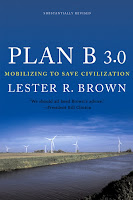 Well, he's the founder of the World Watch Institute, the president of the Earth Policy Institute and a man the Washington Post called "one of the world's most influential thinkers"on world population and resources. He's also the author of Plan B, 3.0: Mobilizing to Save Civilization.
Whether you believe in climate change or not (indeed a few family members and friends still enjoy debating this with me) Brown's book is a must read!!
One of the things I appreciate most about Brown's thinking is how 'big picture' he is. He is able to coherently demonstrate the interconnectedness of the many challenges facing humanity, arguing that if we continue with 'Plan A', or ‘business as usual’, which implies not addressing climate change, food security, water scarcity, overpopulation and poverty at the scale and speed required, the cost will be human civilization itself! As much as I hope this is not so, I agree with him that we need to act NOW to change how we tread on the earth, how we co-exist as a species, and how we relate to all that crawl and canter and soar.
Brown was recently interviewed on CBC Radio’s “The Current,” about his take on the state of the world. As Anna Maria Tremonti summarized, he suggests that “we have pushed the natural systems that sustain us to the breaking point”. From Brown's perspective, the heart of our current challenges stem from our growing global population and lack of natural resource management (er, over-consumption!!). As is evident from the food protests/riots here, in Haiti, Bolivia, Cameroon, Malaysia, Pakistan etc etc we are feeling the stresses of our growing population and consumption needs already as food and oil prices climb.
However it is water, not food that Brown suggests is emerging as the principal constraint. He points out that Himalayan glacial melt is a serious concern in Asia... these glaciers are the major supplier of rivers like the Ganges and Yangtze. If they melt completely then their rivers would become seasonal. As Brown explains, "That would be the most massive threat to world food security we've ever been able to predict."
However Brown is a man of solutions. Now that we've got the basic awareness, and growing political will we simply need to invest $190 billion a year on eradicating poverty, stabilizing our global population and restoring the earth's natural systems. So providing micro finance solutions for SMEs is connected to climate change after all... On the development side the package he envisions involves universal primary education (particularly for girls), accessible basic health care and birth control in every village, and food security (supported through lunch programs at schools among other things). On the environmental side he explains the need to invest in soil conservation, reforestation, raising water productivity, and reducing our waste and consumption.
Brown recognizes that $190 billion is a lot of money, however he points out that "we're currently spending a thousand billion (or 1 trillion) dollars a year for military purposes... this is less than one fifth of that!" Here's his interconnectivity again: "What we're beginning to realise, and what some military strategists are beginning to realise is that climate change and population growth and environmental degradation, food and water shortages - these are the new threats to security. So when we look at this $190 billion budget we see it as, in effect, the new security budget." Security budget eh?! That sounds like rhetoric the U.S. administration could embrace!
Brown also talks about some of the things we can do on an individual level. Here's five that you, me and Mamma can get started on...
Beyond Doom and Gloom… 5 things we can do:
--
* 'Mamma' is Amira’s mother but has now suggested that she is my Nubian mama. (I wanted to do a cartwheel the day she told me I’m like a daughter to her). She is strong and patient and welcoming and kind. I’m grateful her family's presence in my life!
** Karkedeh is the Arabic name for hibiscus flower. It is delicious as a hot tea or cold juice… a little bitter like cranberry, and good for lowering blood pressure.
Yet it's important to move beyond the doom and gloom of climate change... to focus on solutions. Let's break down this gargantuan problem into a more manageable conceptual framework. Bill once suggested that in order to bring about positive change three things need to be in place. First is an understanding of the problem... Thanks to folks like Al Gore, David Suzuki, and thousands of other intellectuals/activists we're finally cluing in on both individual and collective levels (with the exception of governments like the U.S. and Canada, to many of their citizens' embarrassment). Second is the will to bring about change... we still have a ways to go on this front, but the international community is finally stepping up to begin discussions! And third is the capability to bring about the change itself... to access and/or mobilize the needed resources (in this case collectively investing in and creating the needed solutions).
This is where Lester Brown comes in.
"Sorry, who is Lester Brown?!" you may be asking...
 Well, he's the founder of the World Watch Institute, the president of the Earth Policy Institute and a man the Washington Post called "one of the world's most influential thinkers"on world population and resources. He's also the author of Plan B, 3.0: Mobilizing to Save Civilization.
Whether you believe in climate change or not (indeed a few family members and friends still enjoy debating this with me) Brown's book is a must read!!
One of the things I appreciate most about Brown's thinking is how 'big picture' he is. He is able to coherently demonstrate the interconnectedness of the many challenges facing humanity, arguing that if we continue with 'Plan A', or ‘business as usual’, which implies not addressing climate change, food security, water scarcity, overpopulation and poverty at the scale and speed required, the cost will be human civilization itself! As much as I hope this is not so, I agree with him that we need to act NOW to change how we tread on the earth, how we co-exist as a species, and how we relate to all that crawl and canter and soar.
Brown was recently interviewed on CBC Radio’s “The Current,” about his take on the state of the world. As Anna Maria Tremonti summarized, he suggests that “we have pushed the natural systems that sustain us to the breaking point”. From Brown's perspective, the heart of our current challenges stem from our growing global population and lack of natural resource management (er, over-consumption!!). As is evident from the food protests/riots here, in Haiti, Bolivia, Cameroon, Malaysia, Pakistan etc etc we are feeling the stresses of our growing population and consumption needs already as food and oil prices climb.
However it is water, not food that Brown suggests is emerging as the principal constraint. He points out that Himalayan glacial melt is a serious concern in Asia... these glaciers are the major supplier of rivers like the Ganges and Yangtze. If they melt completely then their rivers would become seasonal. As Brown explains, "That would be the most massive threat to world food security we've ever been able to predict."
However Brown is a man of solutions. Now that we've got the basic awareness, and growing political will we simply need to invest $190 billion a year on eradicating poverty, stabilizing our global population and restoring the earth's natural systems. So providing micro finance solutions for SMEs is connected to climate change after all... On the development side the package he envisions involves universal primary education (particularly for girls), accessible basic health care and birth control in every village, and food security (supported through lunch programs at schools among other things). On the environmental side he explains the need to invest in soil conservation, reforestation, raising water productivity, and reducing our waste and consumption.
Brown recognizes that $190 billion is a lot of money, however he points out that "we're currently spending a thousand billion (or 1 trillion) dollars a year for military purposes... this is less than one fifth of that!" Here's his interconnectivity again: "What we're beginning to realise, and what some military strategists are beginning to realise is that climate change and population growth and environmental degradation, food and water shortages - these are the new threats to security. So when we look at this $190 billion budget we see it as, in effect, the new security budget." Security budget eh?! That sounds like rhetoric the U.S. administration could embrace!
Brown also talks about some of the things we can do on an individual level. Here's five that you, me and Mamma can get started on...
Beyond Doom and Gloom… 5 things we can do:
- Work to address one or more of the many pressing issues of our time (eg. poverty, food security, water resource management, environmental degradation, conflict etc)
- Encourage governments to invest in environmental research, provide humanitarian aid, and support development (that ol’ 0.7% as suggested in the Millennium Development Goals)
- Eat lower down on the food chain!! (According to Brown avoiding meats is the equivalent of downsizing from an SUV to a Prius!!)
- Reduce individual consumption (energy, water, resources)
- Talk about these issues with others!!
--
* 'Mamma' is Amira’s mother but has now suggested that she is my Nubian mama. (I wanted to do a cartwheel the day she told me I’m like a daughter to her). She is strong and patient and welcoming and kind. I’m grateful her family's presence in my life!
** Karkedeh is the Arabic name for hibiscus flower. It is delicious as a hot tea or cold juice… a little bitter like cranberry, and good for lowering blood pressure.
Saturday, May 17, 2008
the PPIC-Work impact... Dr M's thoughts
As the PPIC-Work project continues in its final year of programming, one of the fun parts of my job is interviewing different people involved in the project for their thoughts. Here's a discussion I had with "Dr. M"...
 But before we get going, let me give you a bit of context. Mamdouh Foad is the Executive Director of EACID – the Egyptian Association for Community Initiatives and Development – an MFI based in Aswan that serves as one of the core partners of the PPIC-Work project. Dr. Mamdouh (here shown with his wife and field coordinator Seham) is also the in-country Associate Director of the project and has been involved in PPIC-Work from the earliest planning stages. For all you MEDA members in the crowd he and EACID host MEDA tours that come through Egypt, connecting you folks to the local dynamics of the project.
While we're talking context, let me tell you a bit about the organization too. EACID has a history of working with micro and small enterprises in business startup and expansion. In this work, EACID learned that often, Egyptian children are drawn into work as businesses grow. Dr. Mamdouh, Richard Carothers and others asked themselves how they could use their knowledge of business support and microfinance in Egypt to maintain best practices in the industry and at the same time improve the situation for working children. Voila, in 2002, the PPIC-Work project was born.
So what pray tell is the impact of the PPIC-Work project?
Through PPIC-Work Dr. Mamdouh believes MEDA/PTE and their Egyptian partners are building a model whereby MFIs can play an active role in helping children who work without being confrontational to the business owners. By developing a series of participatory social interventions to improve the learning opportunities and working conditions of children who work, he describes project partners as “at the cutting edge” of the microfinance industry. As he explains, “Micro-credit is a very powerful tool. It’s a limitation if we only use it for accessibility… We as an MFI have to discover what we can do with it. It’s not only the accessibility: we can go beyond that. Now, it’s a fact: our skills and expertise have a very dramatic effect over the lives of businesses – for business owners, the businesses themselves, for the workers, for the children for even the community, for even laws and decisions and different stakeholders. I think we have begun to realize our own strengths here.”
Since Dr. Mamdouh has been involved with PPIC-Work from the very beginning, he has a unique perspective of the fruits of the project. In his own words: “If you saw the same children you are seeing now, [six years ago], you would not believe it!” When EACID first started their education classes, rights awareness sessions and artistic programming the children had low self-esteem, poor social skills, and felt stigmatized because they were working. They believed that others would look down on them as poor, as inferior, as children without a future who should not be associated with because they had to work. Dr. Mamdouh suggests that if you look at these same children now they have become more open, have a high self-esteem, believe they have a bright future, are proud that they are working, know about something called their rights and are practicing and demanding these. In short, he says, “There has been a 180 degree change.”
 Dr Mamdouh recognizes that microfinance is not a magic tool that can solve all the complex challenges of poverty or inequality… it has its limitations. He suggests that even as an MFI “You need [to offer] other support programs, and non-financial services to provide a complete package.” Furthermore, protecting the interests of working children is bigger than any one organization can address alone. He explains, “That’s why we are sharing our information, techniques and model with other MFIs. We’d like to see these ideas implemented worldwide even!” He and the PPIC-Work team are optimistic that the intervention tools developed over the past six years will reach a much larger group of working children through the creation of a regional project in 2009. Insha’allah - God willing!
--
In the coming months stay tuned for perspectives of parents and business owners about the impact of Canadian taxpayers' investments. One of these days, you may even get my twenty piesters!
 But before we get going, let me give you a bit of context. Mamdouh Foad is the Executive Director of EACID – the Egyptian Association for Community Initiatives and Development – an MFI based in Aswan that serves as one of the core partners of the PPIC-Work project. Dr. Mamdouh (here shown with his wife and field coordinator Seham) is also the in-country Associate Director of the project and has been involved in PPIC-Work from the earliest planning stages. For all you MEDA members in the crowd he and EACID host MEDA tours that come through Egypt, connecting you folks to the local dynamics of the project.
While we're talking context, let me tell you a bit about the organization too. EACID has a history of working with micro and small enterprises in business startup and expansion. In this work, EACID learned that often, Egyptian children are drawn into work as businesses grow. Dr. Mamdouh, Richard Carothers and others asked themselves how they could use their knowledge of business support and microfinance in Egypt to maintain best practices in the industry and at the same time improve the situation for working children. Voila, in 2002, the PPIC-Work project was born.
So what pray tell is the impact of the PPIC-Work project?
Through PPIC-Work Dr. Mamdouh believes MEDA/PTE and their Egyptian partners are building a model whereby MFIs can play an active role in helping children who work without being confrontational to the business owners. By developing a series of participatory social interventions to improve the learning opportunities and working conditions of children who work, he describes project partners as “at the cutting edge” of the microfinance industry. As he explains, “Micro-credit is a very powerful tool. It’s a limitation if we only use it for accessibility… We as an MFI have to discover what we can do with it. It’s not only the accessibility: we can go beyond that. Now, it’s a fact: our skills and expertise have a very dramatic effect over the lives of businesses – for business owners, the businesses themselves, for the workers, for the children for even the community, for even laws and decisions and different stakeholders. I think we have begun to realize our own strengths here.”
Since Dr. Mamdouh has been involved with PPIC-Work from the very beginning, he has a unique perspective of the fruits of the project. In his own words: “If you saw the same children you are seeing now, [six years ago], you would not believe it!” When EACID first started their education classes, rights awareness sessions and artistic programming the children had low self-esteem, poor social skills, and felt stigmatized because they were working. They believed that others would look down on them as poor, as inferior, as children without a future who should not be associated with because they had to work. Dr. Mamdouh suggests that if you look at these same children now they have become more open, have a high self-esteem, believe they have a bright future, are proud that they are working, know about something called their rights and are practicing and demanding these. In short, he says, “There has been a 180 degree change.”
 Dr Mamdouh recognizes that microfinance is not a magic tool that can solve all the complex challenges of poverty or inequality… it has its limitations. He suggests that even as an MFI “You need [to offer] other support programs, and non-financial services to provide a complete package.” Furthermore, protecting the interests of working children is bigger than any one organization can address alone. He explains, “That’s why we are sharing our information, techniques and model with other MFIs. We’d like to see these ideas implemented worldwide even!” He and the PPIC-Work team are optimistic that the intervention tools developed over the past six years will reach a much larger group of working children through the creation of a regional project in 2009. Insha’allah - God willing!
--
In the coming months stay tuned for perspectives of parents and business owners about the impact of Canadian taxpayers' investments. One of these days, you may even get my twenty piesters!
Sunday, May 11, 2008
Finding Home in Aswan
This afternoon I visited my new friend Amira. We enjoyed a meal she cooked for us, conversed in my broken Arabic, and watched an Egyptian film from the 1960s with her mother. In classic Nubian fashion, her family has a simple and clean house, with high rounded ceilings and open courtyards. It’s beautiful.
 Amira and her mother (cutting okra, right) invited me to sleep over badda-bokrah (the day after tomorrow), to be a part of their family always, and host my own family if/when they come to visit this fall. I brought them cookies, as is the Egyptian custom, though I feel I’m the one who’s been given the gift. I feel I have been welcomed into Egyptian life in ways I have rarely been welcomed before. For the first time I feel that there is a place for me here. It brings tears of joy to my eyes, and silly smiles I could not hide on my walk home just now.
Moments before, as the small passenger ferry glided across the nile towards Aswan I was transported back to another city I felt at home in, on another continent… Geneva. I asked myself what triggered these feelings of belonging in each city, and realised it was that I felt accepted for who I was, despite my foreignness. It was the ability to communicate across cultures, to walk by the water and meet interesting people from around the world, to share a sense of humanness.
Today I feel I’ve finally made a breakthrough here… past people’s conception of me as ‘money’, ‘sex’ or ‘other’ to human. On the ferry I was chatting a little with the women around me, and it was comfortable. At the beginning one asked me for a pen (a typical thing to ask from a foreigner), and I obliged. A few minutes later when she learned that I live in Aswan she returned the pen - recognition of our common humanity, our common belonging here. I was moved.
As I walked home afterwards I was almost able to float above the hassling without notice, and dance along with the festivities in the ‘wedding district’ close to the flat. I feel I am starting to understand things, and am increasingly at peace with them. There will be times that I am judged, but there are times that I also judge. That is part of our humanness too. Hamdallah for moments beyond the judgments, for moments of belonging.
 Amira and her mother (cutting okra, right) invited me to sleep over badda-bokrah (the day after tomorrow), to be a part of their family always, and host my own family if/when they come to visit this fall. I brought them cookies, as is the Egyptian custom, though I feel I’m the one who’s been given the gift. I feel I have been welcomed into Egyptian life in ways I have rarely been welcomed before. For the first time I feel that there is a place for me here. It brings tears of joy to my eyes, and silly smiles I could not hide on my walk home just now.
Moments before, as the small passenger ferry glided across the nile towards Aswan I was transported back to another city I felt at home in, on another continent… Geneva. I asked myself what triggered these feelings of belonging in each city, and realised it was that I felt accepted for who I was, despite my foreignness. It was the ability to communicate across cultures, to walk by the water and meet interesting people from around the world, to share a sense of humanness.
Today I feel I’ve finally made a breakthrough here… past people’s conception of me as ‘money’, ‘sex’ or ‘other’ to human. On the ferry I was chatting a little with the women around me, and it was comfortable. At the beginning one asked me for a pen (a typical thing to ask from a foreigner), and I obliged. A few minutes later when she learned that I live in Aswan she returned the pen - recognition of our common humanity, our common belonging here. I was moved.
As I walked home afterwards I was almost able to float above the hassling without notice, and dance along with the festivities in the ‘wedding district’ close to the flat. I feel I am starting to understand things, and am increasingly at peace with them. There will be times that I am judged, but there are times that I also judge. That is part of our humanness too. Hamdallah for moments beyond the judgments, for moments of belonging.
Tuesday, April 29, 2008
best of Aswan in April...
 Abu Simbel Temple tour

the Aswan postcard shot

Mohammed... a PPIC-Worker


the slaves adding their voices to the mural
Eli and I in tourist mode during her visit
 gorgeous flowers!!

my friend Mustafa
a forbidden photo from inside Abu Simbel...
 the Nubian village my friend Amira lives in

fiery summer blossoms
pensive Eli
Friday, April 18, 2008
March Break, Moving, and Misr
I guess it's been a few weeks since I've had a chance to write anything. Time flies when you're having fun... or in the middle of many changes. Here's a brief update.
As you can tell by the poem below, I recently returned to Canada, for a short stint visiting family and friends, and a bit of work on the side. Some of the highlights from that trip include:
- enjoying fufu and red red with some of the Ghana roomies at a Toronto restaurant blaring authentic beats... what a trip back to the good 'ol days!!
- sharing food with family (both my favourite treats from Egypt and homecooked Canadian meals around our dining room table)
- catching up with Canadian friends over coffee
- cooking deliciousness and hanging out all day with friends in London England
- stocking up on supplies (books, food, music, clothes)
- enjoying a few wonderful soft beds and pillows
- catching up on all the latest movies in the plane rides in between everything
I know these things all sound very material... most of them involve food, but really, it's just the facilitator of wonderful interactions with loved ones (which is what really mattered!!), and the things I needed to recharge my battery! And, it's good to appreciate the little things right?!
When I got back to Cairo, I felt refreshed and ready to take on the next eight months. (I guess I should mention that while in Canada I agreed to extend my contract until mid-December. I feel good about this decision, as it will give me time to see a few things through to their conclusion, learn more arabic, and really deepen in my connections here.) Truth be told, I rather missed the arabic, and many aspects of life here that I am really enjoying. Coming back, it was easy to slip into old routines, and to start creating new ones... it was like a second chance at balancing work and personal life, and making sure I'm really present in this experience. I'm grateful for this opportunity!
After a few weeks in Cairo, it was time to begin planning for a move to Aswan!! While it was hard to say goodbye to my room-mate (who will leave Egypt before I return to Cairo), I was happy to be leaving the chaos of Cairo for a few weeks... particularly for the beautiful peace of Aswan. Aswan is one of my favourite places in Egypt... if not the world! It is a gorgeous blend of desert and lush palm trees, a river afloat with feluccas, and quaint islands full of laid back Nubians who will happily show you their farmland and village. I know I'm painting the idyllic picture here, but I really love this side of the area, the slower pace of life of the town, and lack of pollution!! Of course there are lots of tourists who take the Nile cruises up to Luxor, and therefore there's lots of hassling Egyptians, but i'll take that over the physical harassment I've experienced in Cairo any day! I've now been in Aswan for half a week and am enjoying my new neighbourhood, interactions with landlords and EACID staff and locals, and the opportunity to live this as well as the Cairo life!
More soon...
As you can tell by the poem below, I recently returned to Canada, for a short stint visiting family and friends, and a bit of work on the side. Some of the highlights from that trip include:
- enjoying fufu and red red with some of the Ghana roomies at a Toronto restaurant blaring authentic beats... what a trip back to the good 'ol days!!
- sharing food with family (both my favourite treats from Egypt and homecooked Canadian meals around our dining room table)
- catching up with Canadian friends over coffee
- cooking deliciousness and hanging out all day with friends in London England
- stocking up on supplies (books, food, music, clothes)
- enjoying a few wonderful soft beds and pillows
- catching up on all the latest movies in the plane rides in between everything
I know these things all sound very material... most of them involve food, but really, it's just the facilitator of wonderful interactions with loved ones (which is what really mattered!!), and the things I needed to recharge my battery! And, it's good to appreciate the little things right?!
When I got back to Cairo, I felt refreshed and ready to take on the next eight months. (I guess I should mention that while in Canada I agreed to extend my contract until mid-December. I feel good about this decision, as it will give me time to see a few things through to their conclusion, learn more arabic, and really deepen in my connections here.) Truth be told, I rather missed the arabic, and many aspects of life here that I am really enjoying. Coming back, it was easy to slip into old routines, and to start creating new ones... it was like a second chance at balancing work and personal life, and making sure I'm really present in this experience. I'm grateful for this opportunity!
After a few weeks in Cairo, it was time to begin planning for a move to Aswan!! While it was hard to say goodbye to my room-mate (who will leave Egypt before I return to Cairo), I was happy to be leaving the chaos of Cairo for a few weeks... particularly for the beautiful peace of Aswan. Aswan is one of my favourite places in Egypt... if not the world! It is a gorgeous blend of desert and lush palm trees, a river afloat with feluccas, and quaint islands full of laid back Nubians who will happily show you their farmland and village. I know I'm painting the idyllic picture here, but I really love this side of the area, the slower pace of life of the town, and lack of pollution!! Of course there are lots of tourists who take the Nile cruises up to Luxor, and therefore there's lots of hassling Egyptians, but i'll take that over the physical harassment I've experienced in Cairo any day! I've now been in Aswan for half a week and am enjoying my new neighbourhood, interactions with landlords and EACID staff and locals, and the opportunity to live this as well as the Cairo life!
More soon...
Subscribe to:
Posts (Atom)
